Technology Organization Effectiveness Assessment
Understand what is limiting your technology organization
The Technology Organization Effectiveness Assessment helps technology leaders identify what is getting in the way of reliable operations and predictable software delivery — then decide what to address first.
The pilot covers all five assessment areas for one team of up to 10 people. The assessment takes approximately 2–4 weeks. You receive a PDF report with findings, priorities, and suggested next steps, followed by three progress meetings at 30, 60, and 90 days.
The call is a low-pressure way to share your situation and check whether the pilot fits. It is not a consulting session, and booking it does not commit you to the assessment.
Is this the problem you need to solve?
This assessment may be useful if incidents keep displacing planned work, delivery dates are difficult to predict, or teams are unclear about who owns systems and decisions.
You may also be dealing with knowledge silos, growing technical debt, sustained team pressure, or difficulty connecting technical investment to business goals. These are possible signals, not assumptions about your organization. The assessment helps distinguish which constraints are actually relevant.
Who is it for?
The pilot is designed for CTOs, VPs of Engineering, engineering directors and managers, DevOps, SRE and Platform Engineering leaders, and technology business owners responsible for team effectiveness.
It is a fit if you want to understand how work gets done and use that understanding to set priorities with your team.
When it is not the right fit
This is not a code, security, or infrastructure audit, and it is not an evaluation of individual employees. It is also not a tool-selection exercise or an engagement to find someone to blame. The pilot provides a diagnosis and recommendations; implementation is not included.
What the assessment covers
We examine all five areas, in the context of your organization:
- Reliability and operational risk — how risks and incidents are handled, and how the organization learns from disruption.
- Software delivery and workflow — where delays, queues, rework, or handoffs make delivery less predictable.
- Organization, ownership, and collaboration — how clear responsibilities are and how dependencies between teams affect outcomes.
- Leadership, decisions, and priorities — how priorities are set and decisions about risk, technical debt, and investment are made.
- People, skills, and workload — how workload, skills development, and reliance on individuals affect the way teams work.
What you receive
- A PDF assessment report, delivered within 14 days of the final assessment meeting. It summarizes observations and context, notes limitations in the available information, and distinguishes findings from hypotheses.
- Prioritized recommendations to help you decide what to address first.
- Suggested next steps for 30/60/90 days, including sequencing, dependencies, and signals your organization may choose to monitor.
- Three follow-up meetings, approximately one hour each, at 30, 60, and 90 days after the assessment is completed. Use them to review progress and discuss obstacles.
The assessment gives you a clearer basis for decisions; it cannot guarantee improvements in reliability, delivery speed, or financial performance. Your organization decides which recommendations to implement and is responsible for implementation.
Scope and fee
The fixed-scope pilot is for one team of up to 10 people and includes all five assessment areas, the 2–4 week assessment, the PDF report, and three follow-up meetings.
PLN 14,000 net if you accept the offer or sign the agreement by January 31, 2027.
PLN 27,000 net from February 1, 2027.
The PLN 14,000 fee applies regardless of when the assessment starts, provided you accept the offer or sign the agreement by January 31, 2027. A team larger than 10 or a different scope would need to be agreed separately before work starts.
The fee covers the assessment and follow-up meetings described here. It does not include implementing the recommendations.
How we work together
- Check the fit. In a free introductory call, we discuss your situation and what you want to understand. You can decide whether to proceed after the call.
- Confirm the scope and schedule. We agree on the team, participants, meeting schedule, and information-sharing arrangements before starting.
- Complete the assessment. The assessment takes approximately 2–4 weeks. Timing depends on participant availability and the agreed schedule.
- Review the report. You receive the PDF report within 14 days of the final assessment meeting.
- Check progress together. We meet for approximately one hour at 30, 60, and 90 days after the assessment is completed.
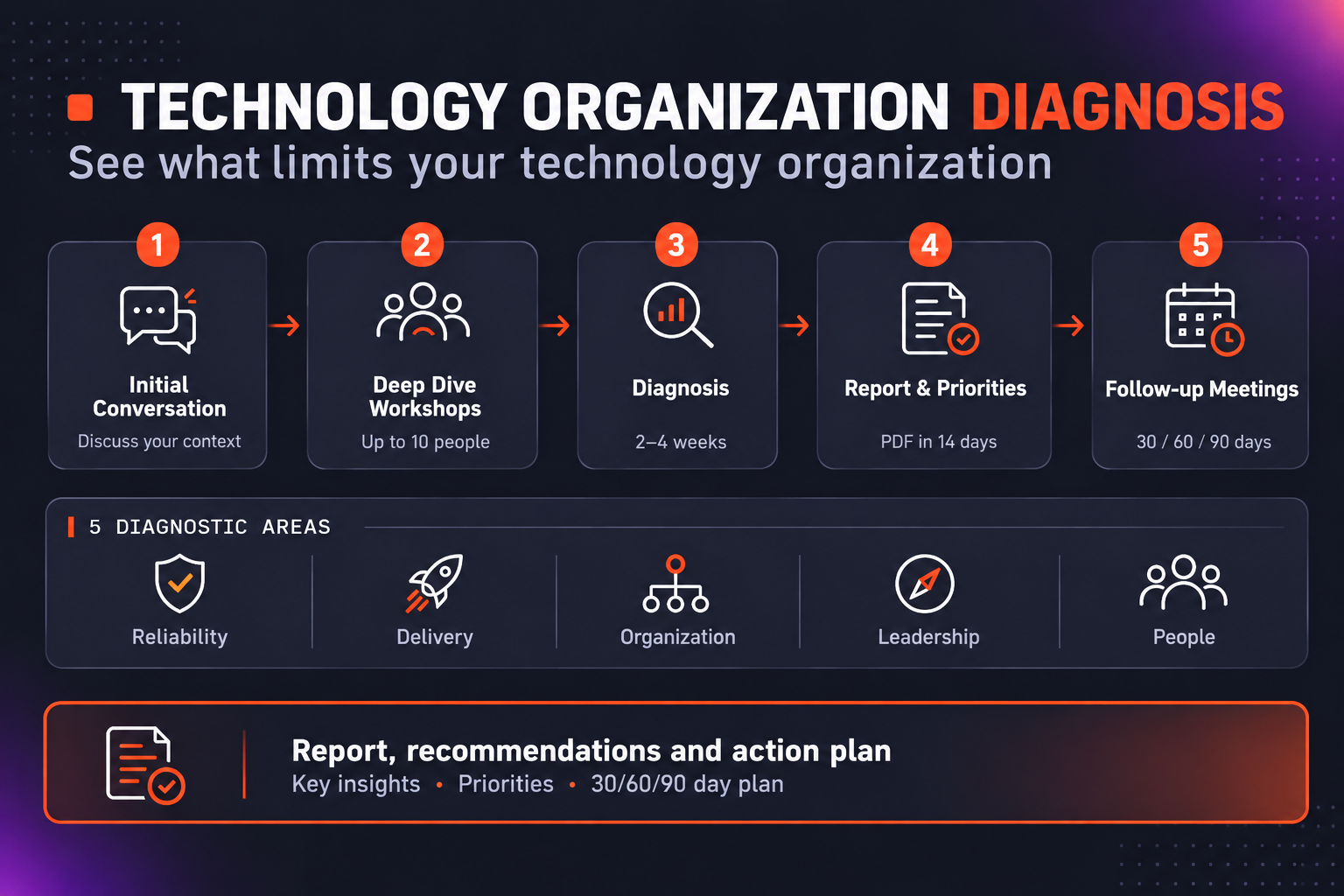
Timeline
The assessment itself takes approximately 2–4 weeks. The report follows within 14 days of the final assessment meeting. The three progress meetings happen 30, 60, and 90 days after the assessment is completed. We confirm the assessment schedule with you before starting.
About the author
Grzegorz Adamowicz has more than 15 years of IT experience across systems administration, backend development, systems architecture, and Site Reliability Engineering. He has also led a DevOps initiative and worked on team development, stakeholder collaboration, resource planning, and people’s growth.
He is co-author of The Linux DevOps Handbook, has written more than 20 technical publications for IT Professional, and organizes technology events. That experience informs an assessment that considers both the systems and the way people make decisions and work together.
FAQ
What happens on the introductory call?
The call is free. We discuss your context and what you want to understand, then decide whether the assessment is a fit. It is not a consulting session and does not include a promised diagnosis or solution. There is no obligation to proceed.
Who should take part, and how much time will it require?
The pilot covers one team of up to 10 people. We agree on participants and meeting times with you before starting. The three follow-up meetings are approximately one hour each; the assessment schedule depends on the agreed scope and participants’ availability.
Do you need production access or sensitive data?
No. Production access or sensitive data is not assumed. Before starting, we agree what information is needed and how it can be shared. An NDA can be signed before the engagement.
Is this a technical audit or an employee evaluation?
No. It examines how the technology organization works, using relevant technical context. It is not a code review, security test, infrastructure audit, or assessment of individual employees.
Who implements the recommendations?
Your organization decides which recommendations to act on and is responsible for implementation. The three follow-up meetings provide space to review progress and discuss obstacles; implementation work is not included.
Will you name our organization or use our logo?
Not without your prior consent. I may ask for feedback, a reference, or permission to name your organization or use its logo after the engagement. All of these are optional, and nothing will be shared without your permission.
Start with a conversation
If the scope and fee look right, book a free introductory call. We’ll discuss your situation, confirm whether the pilot fits, and you can decide what to do next.
No pressure to proceed. The call is not a substitute for the assessment.